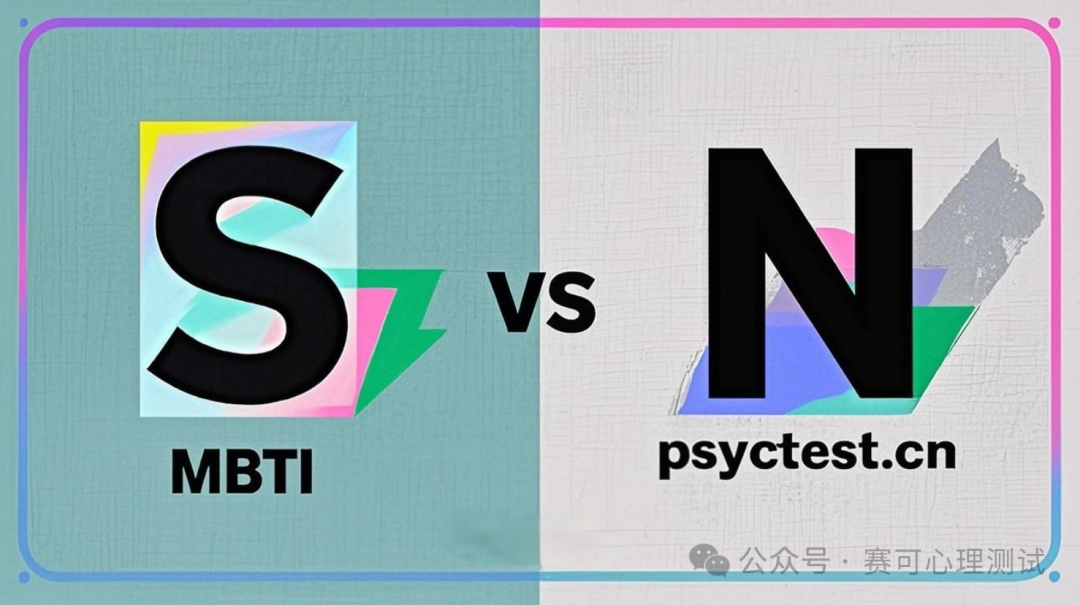
Among the four dimensions of MBTI, the difference between S and N (Sensing and Intuition) is the most easily misunderstood pair. Many people know that they are 'S type' or 'N type', but they can't explain the difference between these two cognitive styles.
This article uses specific examples to explain the difference between S and N, to help you determine which side you prefer, and to help you understand those around you who 'think completely differently from you.'
1. What do S and N stand for?
The second dimension of the MBTI describes the way a person receives information :
- S (Sensing) : Focus on specific information directly perceived through the five senses - facts, details, data, and current reality.
- N (Intuition) : Pay attention to the patterns, connections, possibilities and future trends behind the information - abstract concepts, metaphors, inspiration.
To put it simply: S looks at 'what is', N looks at 'what might be'.
2. Comparison of the core differences between S and N
| Dimensions | S (real sense) | N (intuition) |
|---|---|---|
| focus | concrete facts, details, present | Overall model, possibility, future |
| expression | specific, literal, step-by-step | abstract, jump, use metaphors |
| trusted source | experience, actual data | Intuition, inspiration, theory |
| learning preferences | Hands-on practice, step-by-step | Understand the framework first, then fill in the details |
| face new things | Let’s first look at what it is and how to use it | Think first about what it might become |
3. A specific example: seeing a tree
Suppose two people see a tree at the same time:
- S-shaped people will say: 'This is a sycamore tree with five-lobed leaves and gray-green bark. It is about seven or eight meters high.' - TA is describing a fact that can be directly observed .
- N-type people will say: 'This tree reminds me of life and time. How long has it been standing here? How many generations has it seen?' - TA is describing the associations and possibilities triggered by this tree .
There is no right or wrong answer to either answer, they just differ in the default path of information processing .
4. The difference between S and N in daily life
4.1 Communication methods
S-shaped people like concrete, clear, and step-by-step communication. If you say 'Meet you at the coffee shop at three o'clock in the afternoon', he/she will feel at ease; if you say 'let's find a time to chat', he/she will ask 'specifically when'.
N-type people like open and imaginative communication. If you say, 'Let's talk some time,' he or she will start thinking, 'What direction should we talk? What are the possibilities?'; if you say, 'Let's meet at the door of the coffee shop at three o'clock in the afternoon,' he/she may think, 'Why do we have to be so determined?'
4.2 Making decisions
S-type people tend to make decisions based on prior experience and actual data . TA will ask: 'How were similar situations handled in the past? What specific information is available now?'
N-type people tend to make decisions based on future possibilities and a holistic picture . TA will ask: 'Where will this choice take me? Is it consistent with the direction I want?'
4.3 Working style
S-shaped people are good at execution, detail control, and process optimization . TA can do something steadily, meticulously, and replicable.
N-type people are good at ideation, direction judgment, and innovative breakthroughs . TA can see opportunities that others have not seen and propose new possibilities.
5. S and N are not about abilities, but differences in preferences.
A common misconception is that the N-type is 'smarter' or 'deeper' than the S-type . This is wrong.
- S-type people have natural advantages in observation, execution, and grasp of reality ;
- N-type people have natural advantages in imagination, abstract thinking, and insight into the future .
A healthy society needs two kinds of people. Only S without N will lack innovation and direction; only N without S will lack implementation and details.
6. How to judge whether you prefer S or N?
Ask yourself a few questions:
- When you recall a trip, are you more likely to remember the specific places you went, what you ate, who you met , or the feelings and meaning you had at the time, and the changes it brought to you ?
- When someone describes a new plan to you, is your first reaction to ask 'how to do it specifically' , or is it to think 'there may be other ways to play this' ?
- Do you enjoy doing one thing to the extreme , or exploring many possibilities at the same time ?
If the former is common, you prefer S; if the latter is common, you prefer N.
NOTE : Most people are not purely S or N, but fall somewhere on the spectrum. The MBTI measures a tendency , not an absolute classification.
7. What are the S-type and N-type personality types?
Among the 16 MBTI personality types:
- S-type personality (second letter is S): ISTJ, ISFJ, ESTJ, ESFJ, ISTP, ISFP, ESTP, ESFP
- N-type personality (the second letter is N): INTJ, INTP, ENTJ, ENTP, INFJ, INFP, ENFJ, ENFP
If you want to know the specific characteristics of a certain type, you can view the corresponding type interpretation page:
- ISTJ Logistics Engineer Personality Analysis
- ISFJ Guardian Personality Analysis
- INTJ Architect Personality Analysis
- INFP mediator personality analysis
8. Want to confirm whether you are S or N?
Take the free MBTI 16-type personality test. The test results will show your tendency towards the S/N dimension:
- 12-question express MBTI test : about 3 minutes, quickly understand the four-dimensional tendencies
- 93-question standard MBTI assessment : about 15 minutes, with more stable results
- Full 200-question MBTI test : approximately 30 minutes, in-depth assessment of 8 cognitive functions
9. Further reading
- The Difference Between T and F on the MBTI: A Complete Comparison of Thinking and Feeling
- The Difference Between J and P on the MBTI: A Complete Comparison of Judgment and Perception
- The Difference Between E and I on the MBTI: A Complete Comparison of Extroversion and Introversion
Note : MBTI is a personality classification tool. The results are for self-exploration and reference only and do not constitute professional psychological diagnosis, medical advice or career guidance.