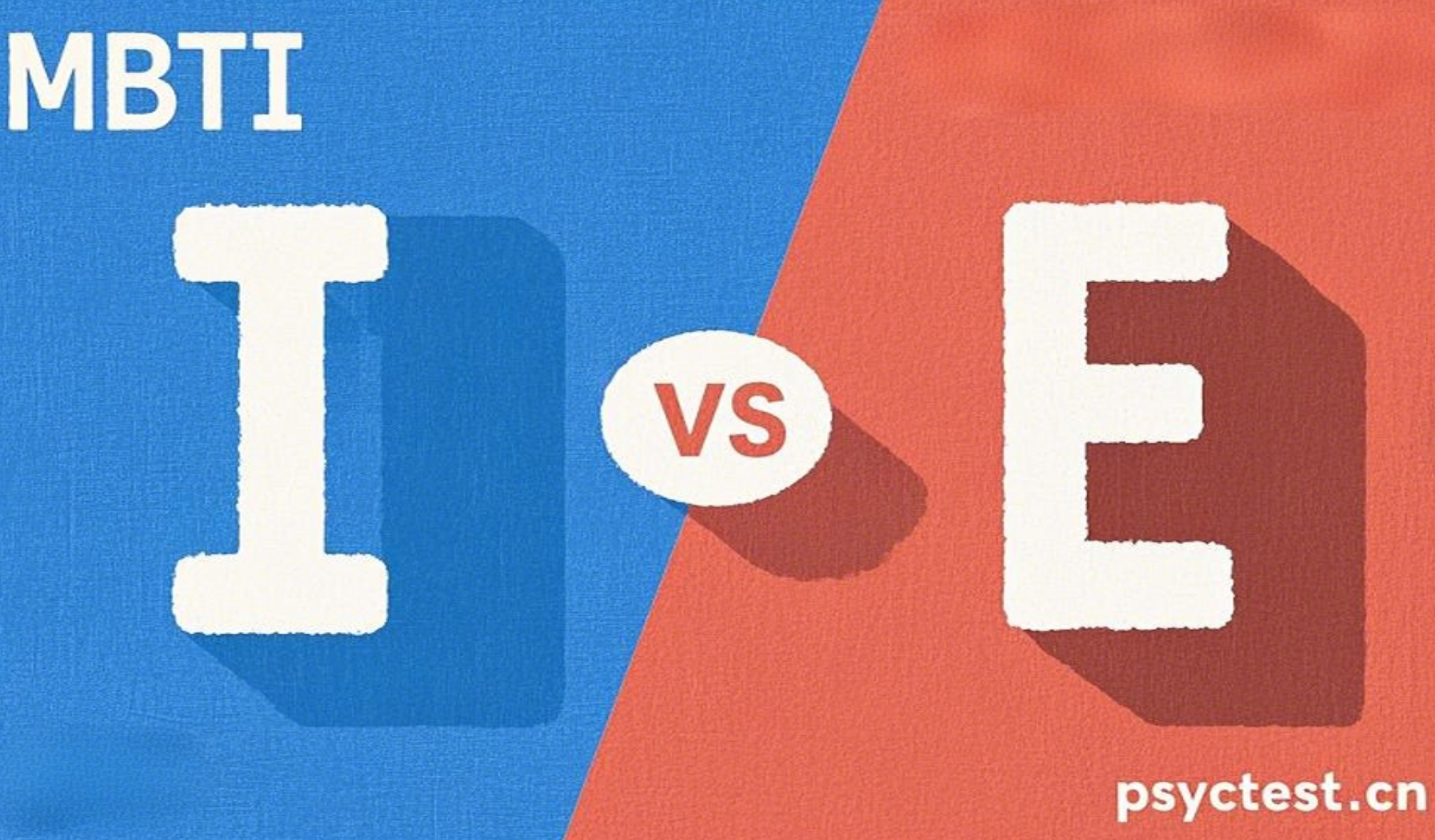
The distinction between E and I (Extraversion and Introversion) is the most widely known and misunderstood of the four dimensions of the MBTI. 'I person' and 'E person' have become buzzwords on the Chinese Internet, but many people's understanding of E and I still remains at the level of 'talkative vs. not talkative'.
This article explains the real difference between E and I and helps you understand your own and other people's energy sources .
1. What do E and I stand for?
The first dimension of MBTI describes the way a person obtains energy :
- E (Extraversion) : Gain energy through interaction with the outside world and social activities.
- I (Introversion) : Gain energy from being alone, reflecting, or spending time with a few close friends.
Simply put: E charges from the 'outside' and I charges from the 'inside'.
2. Comparison of the core differences between E and I
| Dimensions | E (extroverted) | I (introversion) |
|---|---|---|
| energy source | Interaction with people, external stimulation | Solitude, inner reflection |
| way of thinking | Think while talking and organize your thoughts during communication | Think clearly first, then express |
| social preferences | Broad and shallow, likes to meet new friends | Deep and narrow, like deep relationships |
| stimulus tolerance | Like lively, crowded environment | Like quiet, small area environment |
| Recovery method | Chat with friends, go out for a walk | Stay alone, read, and be in a daze |
3. A specific example: attending a party
Suppose two people attend the same party, which lasts three hours:
- The more E-type people talk, the more energetic they become. After the party is over, they may still be unsatisfied and want to find someone to continue chatting with. TA gains energy from 'interaction'.
- Type I people are fine for the first hour, but start to feel tired after two hours, and all they think about is 'when can I go home?' TA consumes energy in 'interaction' and needs to be alone to recover.
The key is not that 'Type I doesn't like socializing' , but that Type I consumes energy in social interactions and needs to be alone to recharge . A type I person can be good at socializing and like friends, but they just need quiet time to recover after socializing .
4. The difference between E and I in daily life
4.1 Ways of thinking
Type E people like to talk and think at the same time . TA organizes her thoughts during the discussion with others, and only thinks clearly about what she wants to say after speaking. Therefore, type E people often 'figure it out as they talk.'
Type I people like to think things through before speaking . TA needs to sort out her thoughts in her mind before she is willing to speak. Therefore, type I people often say nothing in meetings and send a long message alone after the meeting.
4.2 Social preferences
E-type people like to have broad and shallow social interactions: meeting many people, participating in many activities, and being active in groups. TA gets energy from 'people'.
Type I people like deep and narrow social interactions: a few close friends, in-depth conversations, and small gatherings. TA gets energy from 'depth'.
4.3 Working methods
E-type people like open offices, frequent communication, and teamwork . TA generates ideas through interactions and advances work through discussions.
Type I people like quiet environments, independent spaces, and deep concentration . TA generates inspiration in solitude and completes work in concentration.
5. E and I are not 'social vs. non-social'
A common misconception is that E-types are social and I-types are not . This statement is not accurate.
- Type E people may not necessarily be good at socializing, they may just need social interaction to recharge their batteries . A Type E person may also feel awkward at parties and not know how to talk.
- Type I people do not necessarily dislike socializing, they may just need to be alone to recover after socializing . A Type I person can also be very talkative and charming with friends.
The real difference is the 'energy flow' : E-types recharge in social interactions, I-types discharge in social interactions.
6. I 人 E 人: a buzzword on the Chinese Internet
'I person' and 'E person' have become common tags on the Chinese Internet, used to quickly describe a person's social tendencies. But be careful:
- 'I person' does not mean 'social fear'. Many I people have strong social skills, but they need to be alone to recover after socializing.
- 'E people' are not equal to 'social cows'. Many E people are also shy and socially anxious, but they prefer to relieve it through social interaction.
- Most people are not purely I or E, but fall somewhere on the spectrum , exhibiting different tendencies in different situations.
7. How to judge whether you prefer E or I?
Ask yourself a few questions:
- After a busy day, would you rather chat with friends or go for a walk , or would you rather be alone and quiet ?
- In a new environment, would you rather take the initiative to meet new people , or would you rather observe and wait for others to come to you ?
- Do you enjoy more lively gatherings with many people , or in-depth conversations with a few friends ?
If the former is common, you prefer E; if the latter is common, you prefer I.
Note : E and I are energy preferences , not social abilities . A Type I person can be very good at public speaking, and a Type E person can also enjoy being alone. Preferences describe the 'default state', not the 'only state'.
8. What are the personality types of Type E and Type I?
Among the 16 MBTI personality types:
- E-type personality (the first letter is E): ENTJ, ENTP, ENFJ, ENFP, ESTJ, ESFJ, ESTP, ESFP
- Type I personality (the first letter is I): INTJ, INTP, INFJ, INFP, ISTJ, ISFJ, ISTP, ISFP
If you want to know the specific characteristics of a certain type, you can view the corresponding type interpretation page:
- ENFP candidate personality analysis
- ENTP debater personality analysis
- INFP mediator personality analysis
- INTJ Architect Personality Analysis
9. Want to confirm whether you are E or I?
Take the free MBTI Type 16 Personality Test:
- 12-question express MBTI test : about 3 minutes
- 93-question standard MBTI assessment : about 15 minutes
- Full 200-question MBTI test : approximately 30 minutes
10. Further reading
- The Difference Between S and N in MBTI: A Complete Comparison of Real Feeling and Intuition
- The Difference Between T and F on the MBTI: A Complete Comparison of Thinking and Feeling
- The Difference Between J and P on the MBTI: A Complete Comparison of Judgment and Perception
Note : MBTI is a personality classification tool. The results are for self-exploration and reference only and do not constitute professional psychological diagnosis, medical advice or career guidance.